Backup batteries spend almost their entire life waiting, and the charger's job is to guarantee they are full the instant the mains fails - yet the obvious method, continuously floating charge current into the pack, is one of the most damaging regimes for NiMH, because a cell held at 100 percent under current lives in permanent recombination. This paper distinguishes float, trickle and standby concepts, explains why continuous float conflicts with NiMH chemistry, and develops the intermittent readiness-charging strategies - pulse maintenance, scheduled top-ups and self-discharge tracking - that keep medical, UPS and emergency packs instantly available while spending the minimum possible life in overcharge. It closes the gap between the maintenance theory of Paper 9 and the reliability requirements of life-safety standby systems.
A backup pack must be at maximum available charge at an unknown failure instant, possibly after months or years connected to the charger, and must deliver its rated burst immediately; unlike a consumer battery it cannot wait to be charged when needed. The charger therefore has to compensate self-discharge continuously over a long standby life while avoiding the overcharge that would shorten that life - a tension between readiness and preservation unique to standby service.
Medical infusion/syringe pumps, monitoring and emergency equipment, UPS modules, fire and security systems add documentation and reliability requirements: the charge strategy must be predictable, fault-annunciating and certifiable, not merely effective on average.
Float charging - holding a constant voltage with whatever current results, as used for lead-acid - and continuous trickle both force a full NiMH cell to sink current through oxygen recombination indefinitely; per Paper 9 this is continuous oxidation, corrosion and heat, and Panasonic-style guidance bounds even C/20 trickle to about 20 hours, which is negligible against a multi-year standby life. A NiMH pack floated for months will lose capacity and dry out precisely when it is expected to be most reliable - the worst possible outcome for backup duty.
NiMH also has no stable full-charge voltage to float against (Paper 15): holding a fixed voltage delivers a temperature-dependent, uncontrolled current, so the lead-acid float concept is both chemically and electrically inapplicable.
The correct strategy inverts the duty cycle: leave the pack at open circuit at or near full, let it self-discharge only slightly (especially with low-self-discharge grades), and apply a brief, controlled top-up on a schedule or when a tracked SOC estimate falls below a threshold - spending minutes in gentle charge rather than years in overcharge. Pulse maintenance (Paper 9) is the continuous-time version of the same idea; scheduled top-up is its calendar-based version, and both bound cumulative overcharge to a tiny fraction of standby time.
With modern LSD NiMH self-discharging only a few percent per month at room temperature, a top-up once every few weeks restores full readiness with minimal stress, and the charger can additionally trigger a top-up after any real discharge event or after exposure to high temperature, which accelerates self-discharge.
Between top-ups a controller integrates self-discharge from a temperature-dependent model (Paper 16) to estimate readiness without measurement, and periodic scheduled charge-discharge exercises both verify actual capacity and recondition voltage depression (Paper 22); trending the capacity recovered during exercises gives early warning of end of life in a safety system, where a failed battery must be flagged long before it is needed. Logging exercise results supports the medical/UPS certification trail.
Temperature is central: standby packs in warm equipment bays self-discharge and age faster, so top-up frequency should track measured temperature and the pack should be physically located away from heat sources - readiness charging and thermal placement are one design problem.

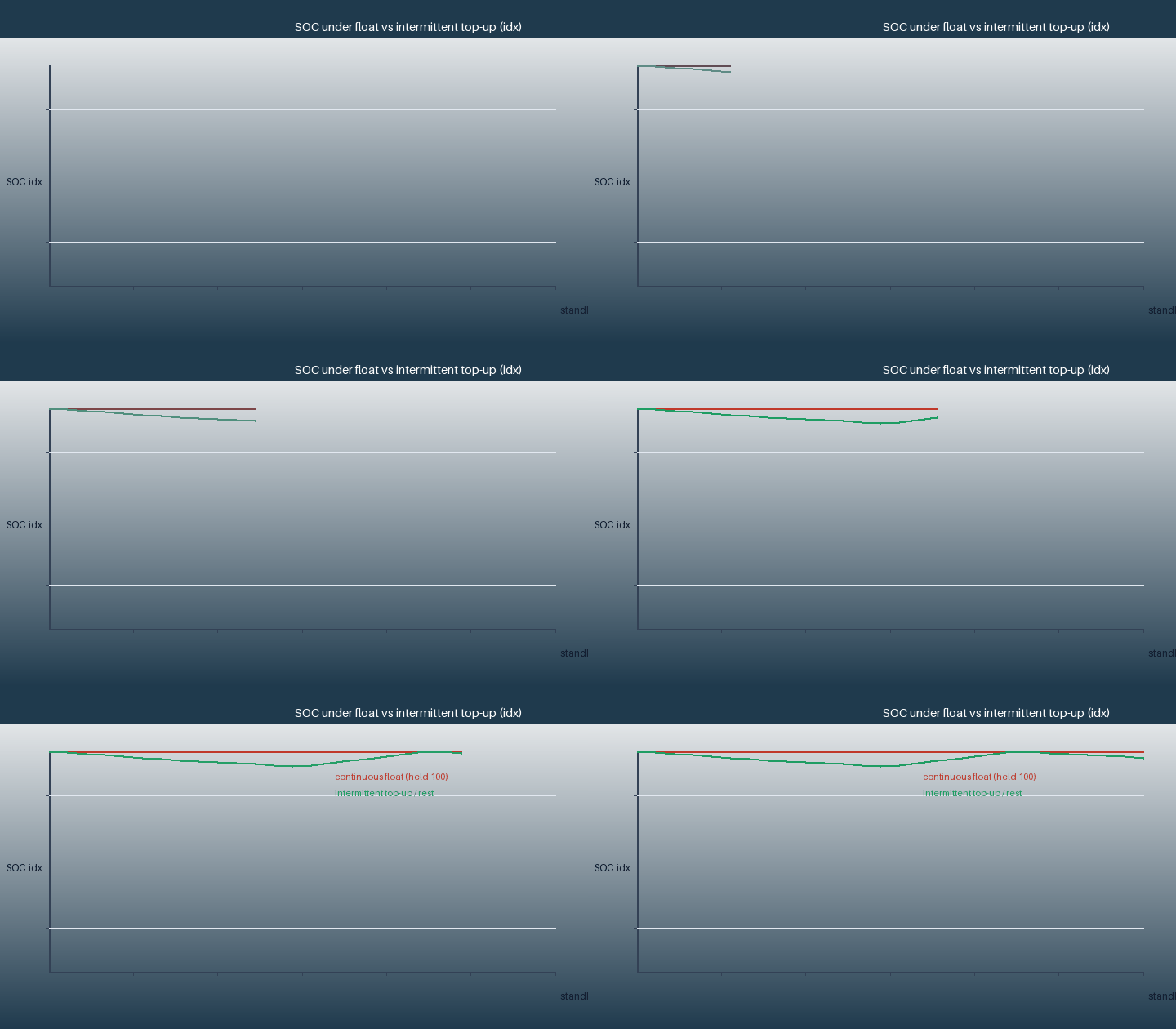
When a top-up runs it should use a gentle, well-terminated charge - moderate current, full multi-criterion termination, no aggressive fast charge into an already-near-full pack - because the pack is usually only a few percent down and a high current would enter the recombination regime almost immediately. A small current to the first valid termination, then back to open circuit, achieves readiness with negligible wear. The first figure contrasts continuous-float overcharge burden with intermittent top-ups; the second sequences a standby readiness cycle including periodic exercise.
Designing the state machine to distinguish 'on charge', 'ready at rest', 'exercising' and 'fault' makes the standby behaviour auditable and the failure modes (sensor fault, cell mismatch, capacity fade) visible to the host system.
Low-self-discharge, high-reliability NiMH grades with documented self-discharge versus temperature and long calendar life are the natural fit, and Weijiang supplies these with standby-charge guidance and capacity-exercise data for medical and backup integrators. The final application paper addresses the opposite current regime - the high-rate packs that power cordless power tools.
Weijiang Power designs and manufactures nickel-metal hydride cells, matched packs and charging-ready configurations for consumer, industrial, medical and mobility customers, and supports partners with charge-protocol guidance, IEC 61951-2 performance files, IEC 62133-1 safety evidence and charger co-validation. Share your cell format, charge rate, thermal envelope and cycle target and our engineers will specify a cell-and-charge combination that protects both runtime and service life. Review the range on the products page.


