What internal resistance is inside a NiMH cell, ACIR vs DCIR measurement, I×Ri voltage sag, I-squared-R heat and how Ri moves with SOC, temperature and age.
Capacity in mAh gets all the attention on a datasheet, but internal resistance is the spec that quietly decides whether a battery performs in a real device. It determines how far voltage sags under load, how much heat a pack generates, how many amps can be delivered in a pulse and how evenly cells age in a series string. For high-drain products — power tools, medical pumps, motors, starter packs — internal resistance matters more than nominal capacity. This article explains what internal resistance actually is inside a NiMH cell, how factories measure it, and how to design around the voltage sag and heat it creates.
Where Internal Resistance Comes From
A NiMH cell is not an ideal voltage source; current moving through it encounters several resistive contributions, usually grouped as:
- Ohmic resistance — the electronic resistance of the nickel foam substrates, current collectors, tab welds and the ionic resistance of the KOH electrolyte and separator. This component responds instantly, like a conventional resistor.
- Charge-transfer resistance — the kinetic barrier of the electrochemical reactions at the electrode surfaces, which depends on catalyst activity, surface area and temperature.
- Diffusion (concentration) resistance — the slower limitation of ions and hydrogen moving through porous electrodes, which appears during sustained loads.
High-rate NiMH cells attack all three: thin, high-surface-area electrodes shorten diffusion paths, highly conductive foam collectors reduce ohmic loss, and electrolyte additives keep ionic conductivity high at low temperature.
Two Ways Factories Measure It
Internal resistance is time-dependent, so two standard measurement methods exist and their numbers are not interchangeable:
- AC internal resistance (ESR) at 1 kHz — a small alternating signal probes the cell; at 1 kHz the slow diffusion processes cannot follow, so the reading captures mainly the ohmic component. It is fast, non-destructive and the standard production-line sorting method (often called ACIR). A quality AA NiMH cell typically reads in the low tens of milliohms.
- DC internal resistance (DCIR) — the cell is stepped between two discharge currents and resistance is calculated as ΔV/ΔI over a defined interval (commonly tens of milliseconds to several seconds). Longer intervals include charge-transfer and diffusion effects, so DCIR is usually higher than ACIR but closer to what a real load experiences.
When comparing suppliers, compare the same method: a 1 kHz ACIR number cannot be set against a 10-second DCIR number.
Ri Drives Voltage Sag
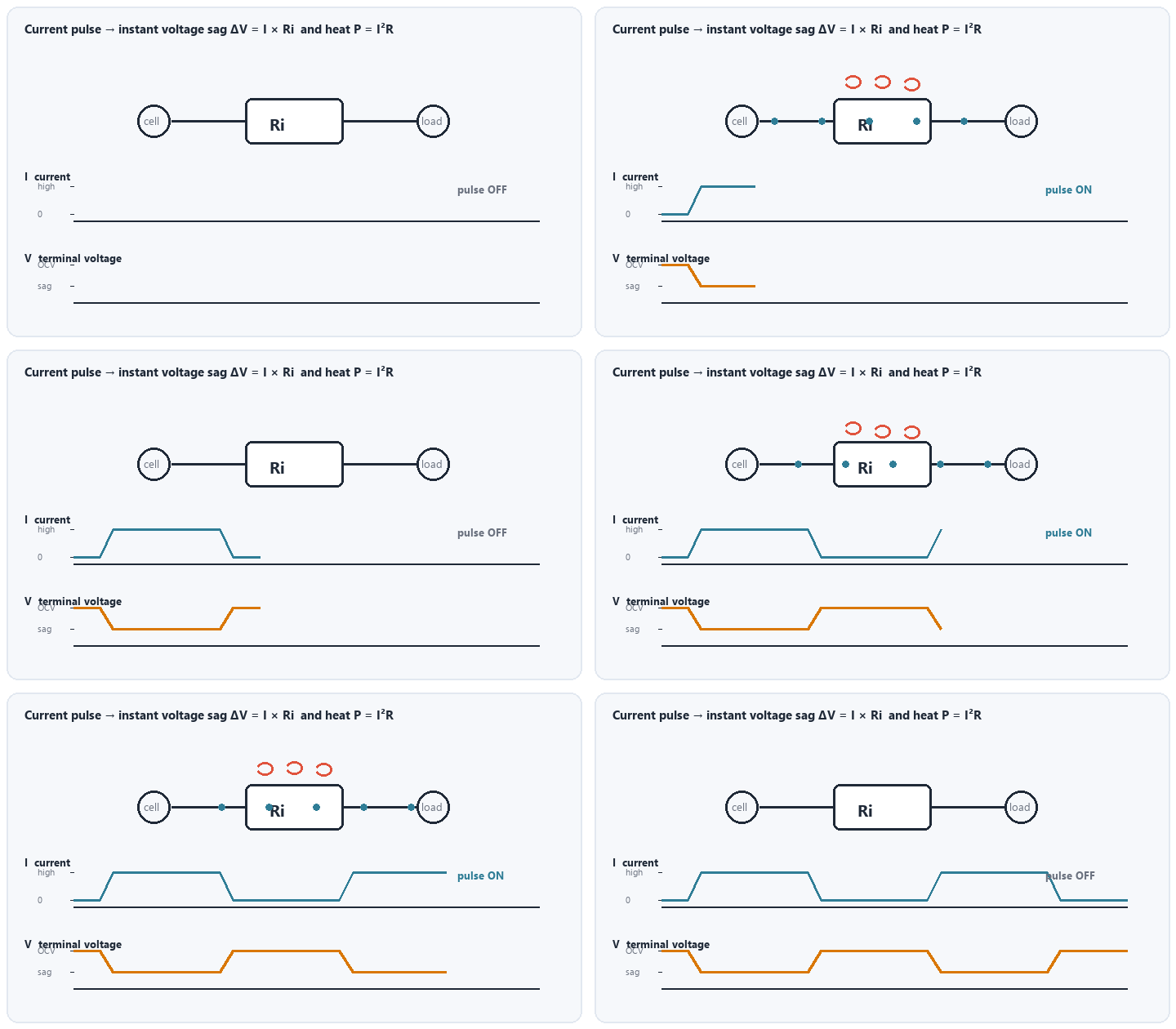
The terminal voltage of a cell under load follows a simple relationship: Vₜ₃ₘₖₐₓₐ₎ = Vₒₐₔₜ − I × Rᵢ. Internal resistance converts current into an immediate voltage drop. Worked example: a cell with 20 mΩ internal resistance carrying a 5 A pulse loses 0.10 V instantly; two cells with 40 mΩ lose 0.20 V under the same pulse — the difference between a motor that starts cleanly and one that browns out its controller. This is why high-rate cells are defined as much by their milliohm reading as by their mAh.
Ri Becomes Heat
The same resistive drop dissipates energy as heat at a rate P = I²R. Because heat scales with the square of current, doubling load current quadruples resistive heating. In a pack, this heat compounds: temperature rises, electrolyte conductivity and electrode kinetics change, and during charging the recombination reaction adds further heat. Low-resistance cells and low-resistance interconnects are therefore the foundation of thermal design — they keep a pack cool far more effectively than cooling added after the fact.
How Ri Moves with SOC, Temperature and Age
- State of charge — resistance follows a shallow U-shape: slightly elevated at full charge, lowest across the mid-SOC plateau, and rising noticeably near empty as active material is exhausted — the electrical signature of the discharge knee.
- Temperature — cold dramatically raises Ri as electrolyte conductivity and reaction kinetics slow, which is why cold-weather high-drain performance demands special grades; warmth lowers Ri but accelerates aging.
- Age and cycling — as cells age, corrosion layers grow, electrolyte redistributes and the electrode structure degrades, so Ri climbs steadily. Tracking resistance over life is therefore a reliable health indicator, and incoming-goods Ri screening catches weak cells before they reach a pack.
Designing Around Internal Resistance
- Specify the grade, not just the capacity — select high-rate cells with a maximum ACIR limit written into the specification.
- Match Ri, not only mAh — series strings should be built from cells binned in the same narrow resistance band so current produces equal sag in every cell.
- Parallel to lower pack resistance — parallel cells share current and halve effective resistance; series raises voltage without changing per-cell sag.
- Minimise interconnect loss — short, wide, multi-tab welds and adequate busbar cross-section avoid adding milliohms the cells worked to eliminate.
- Validate at the pulse — test voltage sag at your worst-case current and temperature, and verify resistance growth over cycle life, not just on day-one samples.
Weijiang Power: Low-Resistance Cells, Tight Resistance Binning
Weijiang Power measures AC internal resistance on every production cell and offers standard and high-rate NiMH grades engineered for low milliohm values and stable resistance across temperature and life. Our pack assembly uses optimised multi-tab welding and matched Ri binning so series strings sag and heat uniformly under load. Share your peak and continuous currents, temperature range and cutoff voltage, and our engineers will select the cell grade and pack topology that keep voltage up and temperature down.


