Most industrial backup is not asked to run for hours. A small uninterruptible power system, a PLC or meter backup, a network edge node or a field instrument is usually asked only to bridge a disturbance: hold the rail through a voltage sag or a brief outage, carry the controller long enough for an orderly shutdown and data flush, or span the gap until a generator comes online. That ride-through duty has its own standard, IEC 62040-3, and its own electrical character. Paper A, the first of three on small-UPS and instrument backup, dissects the duty and the standard's topology classes, and explains why a high-rate nickel-metal hydride pack is a strong fit for a compact, wide-temperature bridge source.
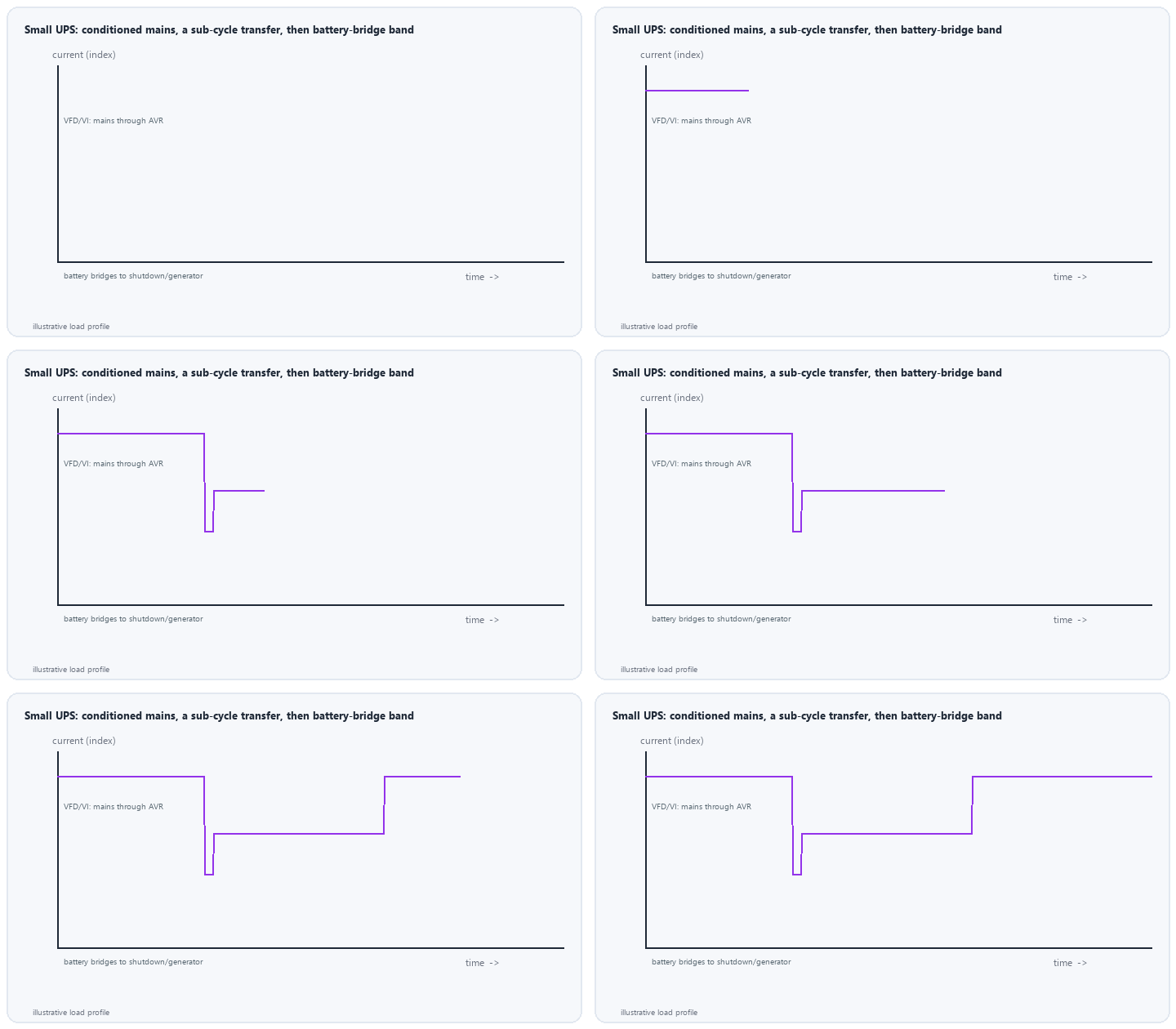
A security or fire panel measures autonomy in hours of low current; a small UPS measures it in seconds to minutes of substantial current. The animated trace shows the characteristic shape: conditioned mains feeding the load under normal operation, a disturbance - sag, brownout or full outage - detected and transferred, and then a battery-bridge band during which the inverter or DC rail carries the instrument until the supply returns, the generator starts or the controlled shutdown completes. The battery's whole life is a long, fully ready wait punctuated by short, relatively high-power events.
That profile changes the cell requirement. Capacity matters less than the ability to deliver sustained moderate current on a stable rail, repeatedly, after months or years at full readiness, often inside a warm or cold control cabinet. Peak and continuous rate capability, low internal impedance and float endurance move ahead of sheer energy density - the axes on which NiMH competes particularly well.
IEC 62040-3 (adopted in Europe as EN 62040-3) classifies UPS performance with a precise vocabulary. The first letter describes the output's dependence on the input supply in normal operation. VFD - Voltage and Frequency Dependent - is the offline or passive-standby topology: the load runs straight from the mains and is transferred to the inverter only when the supply fails, so the output normally tracks mains voltage and frequency and a short transfer (typically a few milliseconds) occurs on outage. VI - Voltage Independent - is the line-interactive topology, which conditions voltage with an automatic voltage regulator while frequency still follows the mains. VFI - Voltage and Frequency Independent - is the double-conversion online topology, which continuously regenerates the output from the DC bus and is therefore independent of both input voltage and frequency, with zero transfer break.
The full classification is a three-character code that adds an environmental class and a performance class, while IEC 62040-1 covers safety and IEC 62040-5 addresses DC UPS - the topology increasingly common for backing DC-powered instruments, PLCs and network gear directly without an AC inverter. Choosing the class is choosing how clean and how uninterruptible the bridge must be, which sets the battery's transfer and rate requirements.
Two design intents set the autonomy target. Bridge-to-shutdown sizes the battery for the controlled wind-down of the protected load: flushing a PLC's retained data, parking an actuator, writing logs and powering down cleanly, which for many instruments and edge devices is a matter of tens of seconds to ten minutes. Bridge-to-generator sizes for the start-up and stabilisation time of a standby generator - commonly tens of seconds - plus margin for a failed first start and a retry. Bridge-to-renewables or bridge-through-fault in a microgrid can demand longer.
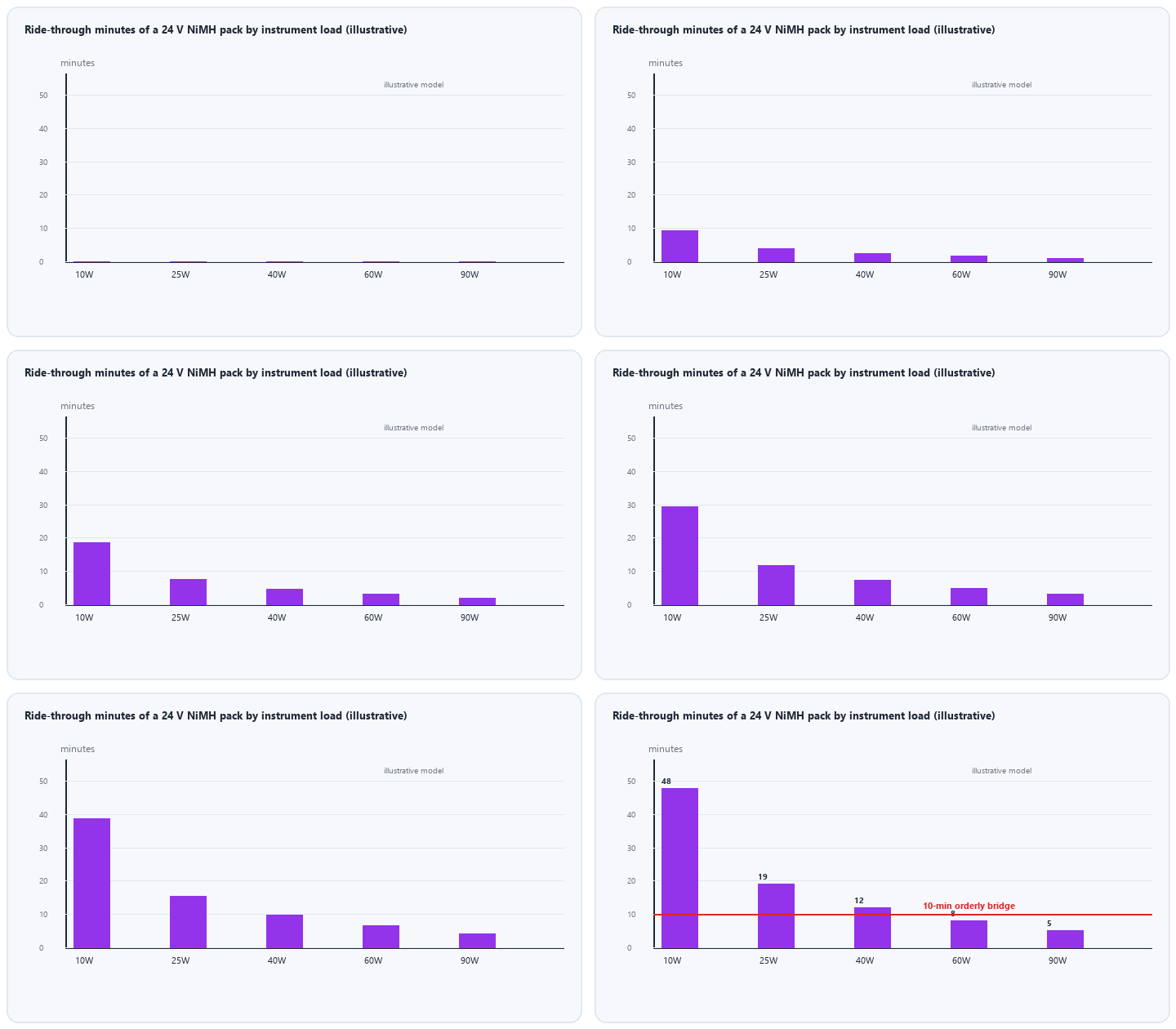
The animated chart converts a fixed 24 V NiMH pack into ride-through minutes across instrument loads. It is an illustrative model, but the inverse relationship is exact: doubling the protected load halves the bridge time. Specifying the load realistically - including the inrush of a contactor or a restarting instrument - is what separates a UPS that completes its bridge from one that collapses halfway through the shutdown sequence.
In a VFD offline UPS the load sees a brief break while the relay transfers to the inverter; in a VI line-interactive design the break is similar but the AVR has already handled sags within its range; a VFI online unit has no break at all because the inverter always feeds the load. Whichever the topology, the battery must accept the load instantly and hold the rail inside the protected equipment's tolerance. A cell string with high internal impedance sags under the step load and can reset the very controller it was meant to protect - a failure mode that looks, misleadingly, like a software crash.
Matched, low-resistance NiMH cells present a stiff DC source with a flat 1.2 V-per-cell plateau, so the rail steps cleanly from charger to battery and the inverter or DC-DC stage sees a stable input through the bridge. A modest hold-up capacitor covers the sub-cycle transfer in a VFD design; the NiMH string then carries the sustained bridge.
Small UPS and instrument backups live where the protected electronics live: sealed control cabinets, outdoor kiosks, factory floor enclosures and roadside or rooftop equipment, where ambient temperature can swing far beyond a comfortable office range. A backup source that is capacity-rated only at 20 degrees C will under-deliver on a winter night or age prematurely in a summer cabinet. Aqueous NiMH tolerates a wide operating range and, in wide-temperature industrial grades, maintains useful delivery in cold that badly weakens lead-acid; its discipline is temperature-aware charging, since sustained charging above roughly 45 degrees C promotes gas evolution and dry-out.
Outages also repeat. A grid-prone location may cycle the UPS dozens of times a year - each event a discharge followed by a recharge - and the battery must retain its bridge capability through hundreds of such cycles. IEC 61951-2's reference endurance of at least 500 cycles frames the expectation; a pack chosen with an end-of-life margin still completes its rated bridge late in life.
Compare the candidate chemistries against the ride-through duty and a clear position emerges. Sealed lead-acid is cheap and familiar but heavy, weak in the cold, sulphates through repeated shallow cycling and long float, and needs bulk to deliver high rate. Lithium is energy-dense but adds protection and balancing electronics and transport weight to a short-duration, high-rate, wide-temperature duty that rarely exploits its energy advantage. Supercapacitors deliver near-infinite cycle life and instant rate but only seconds of energy and steep self-discharge. Nickel-metal hydride occupies a useful middle: high-rate, low-impedance delivery, a flat plateau, good cold performance, intrinsic aqueous safety, no cadmium and the simplest air-freight classification.
Paper B turns this into a sizing and chemistry-selection method; Paper C walks the IEC 62040 and cell-level evidence trail.
Weijiang Power manufactures high-rate NiMH cells and welded packs for small UPS, DC-UPS and instrument/PLC ride-through: AA, sub-C and C strings for seconds-to-minutes bridges, low-impedance matched cells for clean transfer and stable DC rails, wide-temperature grades for sealed cabinets, and IEC 61951-2, IEC 62133-1 and UN 38.3 documentation. Send your protected load, target bridge time, topology (VFD/VI/VFI or DC UPS) and cabinet ambient and we will size a stiff, repeatable bridge pack.


